


November 2026
Pope Leo XIV’s Visit to France – In September, from Friday the 25th to Monday the 28th, 2026, Pope Leo XIV brought a very bright light to France. His genuine smile, his openness, warmth, and encouragement, and his positive sense for peace and fraternity touched everyone deeply. On Friday evening, the 80,000 young persons in the Stade de France welcomed him like a star, and he returned their enthusiasm. On Saturday afternoon, he celebrated Mass in the open air on the Place de la Concorde and the Champs-Elysées in Paris, where 800,000 persons were present. 3000 priests and deacons served communion to many of these persons. At Lourdes, he gave succor and appreciation to poor, elderly and sick persons. Pope Leo led the faithful – Catholics and persons of all beliefs – in prayer for a better world and goodwill amongst all of us. Everything was entirely peaceful, without any incidents. Everyone felt uplifted.
❀ ❀ ❀ ❀ ❀
Unfortunately, the mood did not last long. Soon after the departure of the Pope, high school students restarted their demonstrations of mid-September, and these expanded during the following weekends. On Saturday, October 17, the situation was dramatic and violent, with uprisings all over France. University students, parents, the Gilets Jaunes (the “yellow vests” movement in 2018-2020), and the major trade unions joined in. The Ministry of the Interior estimated there were 550,000 demonstrators all over the country – the trade unions claimed there were 800,000.
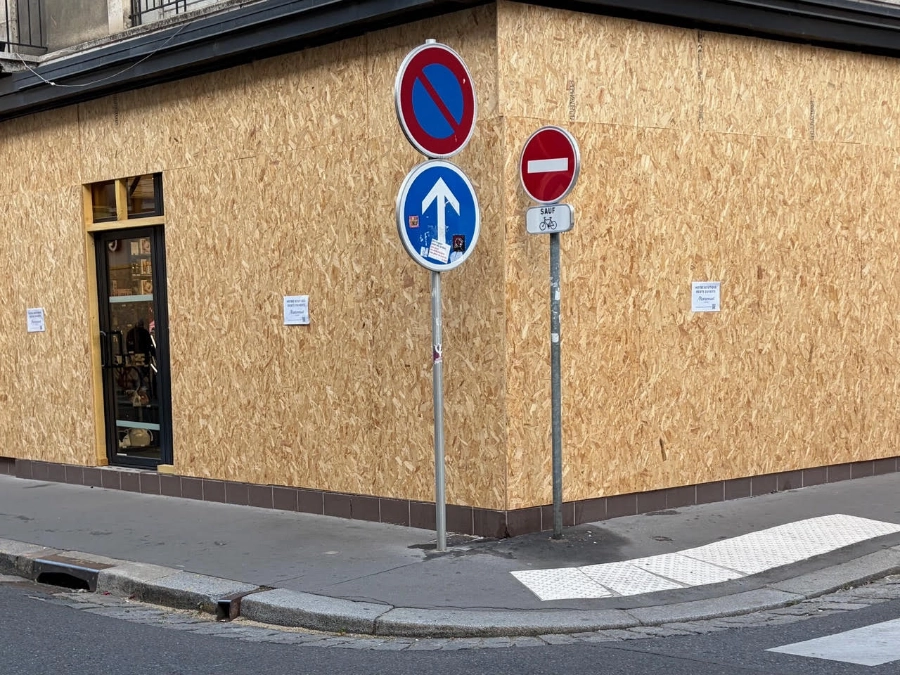
Much more seriously, the Black Blocs (ultra left partisans with black hoods and masks), casseurs and hooligans infiltrated into the crowds and engaged in serious destruction and vandalization of public buildings, stores and windows, entering and stealing anything they could grab. They attacked big stores and small neighborhood shops owned by a single entrepreneurs or families, often seriously damaging their businesses. They set fire to buildings and automobiles in the streets, including the 19th century Mairie (city hall) of Limoges, which was largely destroyed with all of its public documents.
After the demonstrations on October 17, President Macron gave a 10-minute televised speech, and the next day he left for the Middle East.
On Saturday, October 24, there were more marches all over France, but some local prefects prohibited actions, and more police and security personnel were put on the streets. There were fewer hooligans and less destruction, but still with thousands participating. At the same time, October 24-25, in Orléans, there was a congress of the Rassemblement National (RN), the ultra-right party of Marine Le Pen. There were huge gatherings of RN supporters and many anti-RN ultra-left Jean-Luc Mélenchon supporters, but without any significant violence.
More protests were held on October 31 (Halloween), November 5 (575,000 participants), November 14 (106,000 participants), November 17 (146,000 participants according to the Interior Ministry, including public sector workers, and 500,000 as stated by the CGT Union) (except as noted, the participation figures are from the Interior Ministry). A website has been created with the agenda of future strikes and demonstrations.
People are getting tired of the situation. The police, 70,000 of them, have been deployed every weekend in the whole of France, and they are fatigued. Some schools have been attacked and burned, and some have been temporarily closed due to radical student actions. Still, some students want to get back to class and to studying to be ready for exams at the end of the year. Parents are concerned about their children getting on with their education.
Since September, President Emmanuel Macron has travelled to the Netherlands and the United Kingdom (Sept 2-3), New York (UN Sept 21-23), Madrid (Sept 29-30), the Middle East (5 countries, Oct 19-21), Dublin (EU meetings, Nov 12-13), Cambodia (state visit, Francophonie summit, Nov 14-16), and Malaysia (Nov 16-17). In December, he will visit the United States (the G20 meeting in Miami, Dec 14-15) and Brussels (EU, Dec 17-18).
The main protest claims are:
Cost of Living – It has gone up by 23% since Emmanuel Macron became President in 2017 (Le Monde). The rise has been over 3% just in 2026. Gasoline prices have risen 28% over a year ago. The highest price this fall was 2.13 € per liter (about $9.50 per US gallon). The current price has declined to about 1.99 € per liter (about US$8.27 per US gallon).
Education – The students are calling for better classrooms and facilities, replacements for absent teachers, better scheduling of classes, and modern, relevant and stimulating education. They want greater transparency and fairness in the “Parcoursup” higher education admissions portal. After October 17, the Minister of Education reacted declaring there would be 3000 additional teachers within three days!
During Emmanuel Macron’s two terms as President, there have been seven Ministers of Education. Funding for education comes 82% from the State and local authorities, rising from 148 € billion in 2015 to 197 € billion in 2024 (Ministry of Education figures), about 6.8% of GDP. According to the OECD, French 15-year olds’ reading and math skills have declined by 10% between 2012 and 2025.
Immigration – Many people blame the country’s problems on excessive immigration and unqualified illegal immigrants. In a population of 69 million, the Ministry of the Interior estimates that 6-7 million are foreigners, of which an estimated 700,000 are undocumented.
Public Finance and Debt – The French State debt is currently 3.6 € trillion (approximately US$ 4.2 trillion), 119% of the GDP. The Government’s budget deficit is at 5.1% of GDP, above the EU ceiling of 3%. The interest rate on 10-year State bonds rose to over 5% in October.
Governance – Emmanuel Macron became President of France on May 14, 2017. He came in with hope for change and modernization. In 2018, he had to deal with the union strikes, 2018-2020 with the Gilets Jaunes, the Covid crisis in 2020, the pension reform, and now the demonstrations. President Macron has had seven prime ministers – two in the first term and five since. Sébastien Lecornu has been PM since September 9, 2025.
On June 9, 2024, President Macron dissolved the Parliament. The legislative elections left him with three political groups and no party with a majority.
Elections in 2027 – As of today (November 25), the elections for a new President are scheduled to take place on Sunday, April 18, and on Sunday, May 2, 2027. The leading candidates are Marine Le Pen (far right, about 32%) and Jean-Luc Mélenchon (far left about 18%). There are many other candidates, most in the center, but today none are standing out.
The new President will take office on or before May 14, 2027. Six more months.

Comments