



To Gilbert du Motier, Marquis de La Fayette:
With the celebration of 250 years since the signing of the American Declaration of Independence, we recognize with admiration and gratitude your contribution to the American cause. You went to America at the age of 19 to engage personally in the war against Great Britain. You were instrumental in getting France to provide military and financial support to the Colonists for them to win the War of Independence.
Your full name is Marie-Joseph Paul Yves Roch Gilbert du Motier (in the French tradition, you have multiple first names). You were born on September 6, 1757, into an aristocratic family in Auvergne (in the center of France), with a long military tradition, whose heritage goes back to Joan of Arc in 1429. At the age of two, you became the Marquis de La Fayette following the death of your father, killed by an English cannon ball, a fact that you never forgot.
You were educated at the University of Paris and at the Académie de Versailles. Following a family arrangement, in 1774, when you were 16, you married Adrienne de Noailles who was 14. You had four children, and your marriage lasted until Adrienne’s death in 1807. In 1773, you had received a Lieutenant’s commission in the Noailles Dragoons (your father-in-law’s regiment).
You were intrigued by the new ideas and the philosophy of the Enlightenment (“Les Lumières”) and fascinated by the colonists in America who were challenging British rule on the basis of the new philosophy.
On August 8, 1775, you were at a dinner in Metz (the East of France) with the Duke of Gloucester, the younger brother of King George III of Great Britain, where the Duke ridiculed the American rebels in the British colonies. This attitude shocked you, and the dinner was allegedly a turning point in your thinking.
You decided to support the American colonists and to go off to the United States of America (the official name from September 1776) and fight with the rebels. So, you purchased the sailing ship Victoire and in 1777 left for America. On June 13,1777, you landed on North Island near Georgetown, to the north of Charles Town (today Charleston), in South Carolina.
In America, your name was gradually simplified to “Lafayette”. On July 31,1777, the Continental Congress commissioned you a Major General. In August, you met George Washington (25 years your senior), and you and he became life-long friends. When in December 1779, Adrienne gave birth to your son, you named him Georges Washington Lafayette.
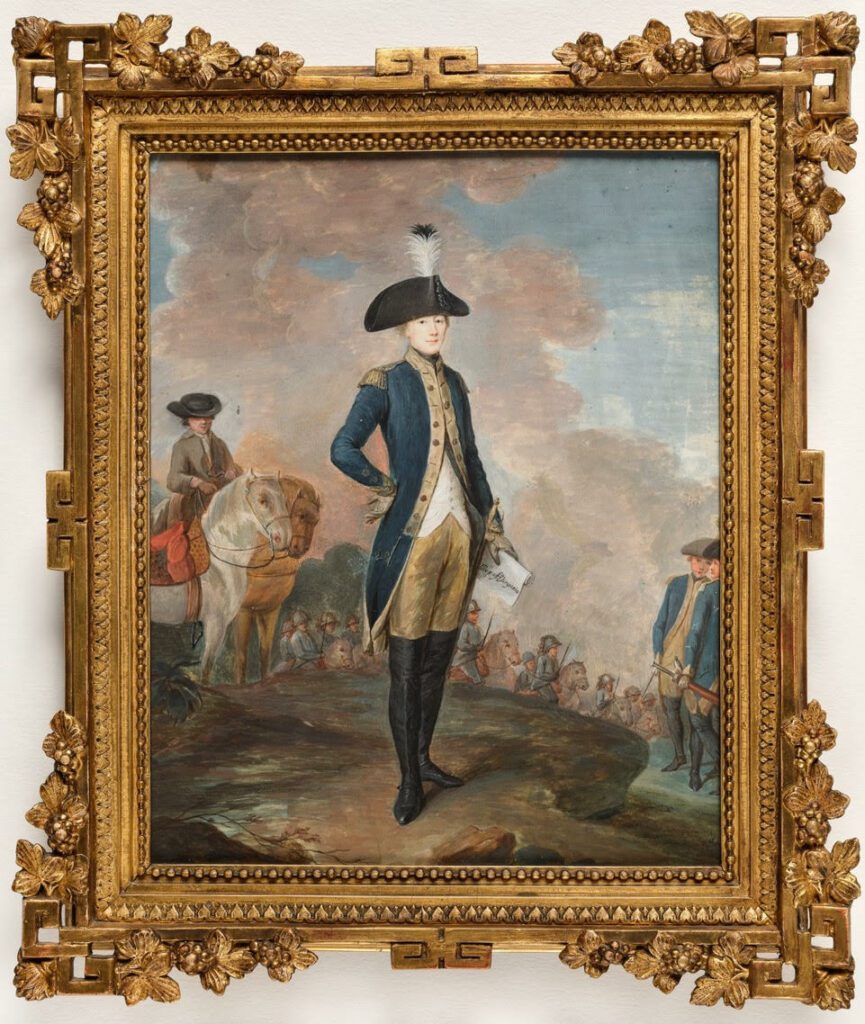
around 1784, gouache on paper.
Paris, Fondation Josée et René Chambrun FC 15.1.42.
In September 1777, you saw action in the Battle of Brandywine in Pennsylvania, where you were wounded in the leg. That winter you were with George Washington at Valley Forge. He sent you to Albany, New York, and while there you recruited the Oneida native tribe to the American cause. They called you Kayewla (fearsome horseman).
Returning to France in February 1779, you received a hero’s welcome, and you went hunting with King Louis XVI.
With Benjamin Franklin, the first American Minister (the 18th century American equivalent of Ambassador) to France, you secured a promise from France of sending 6000 French soldiers to go to America. You left again for America abord the frigate Hermione in March 1780.
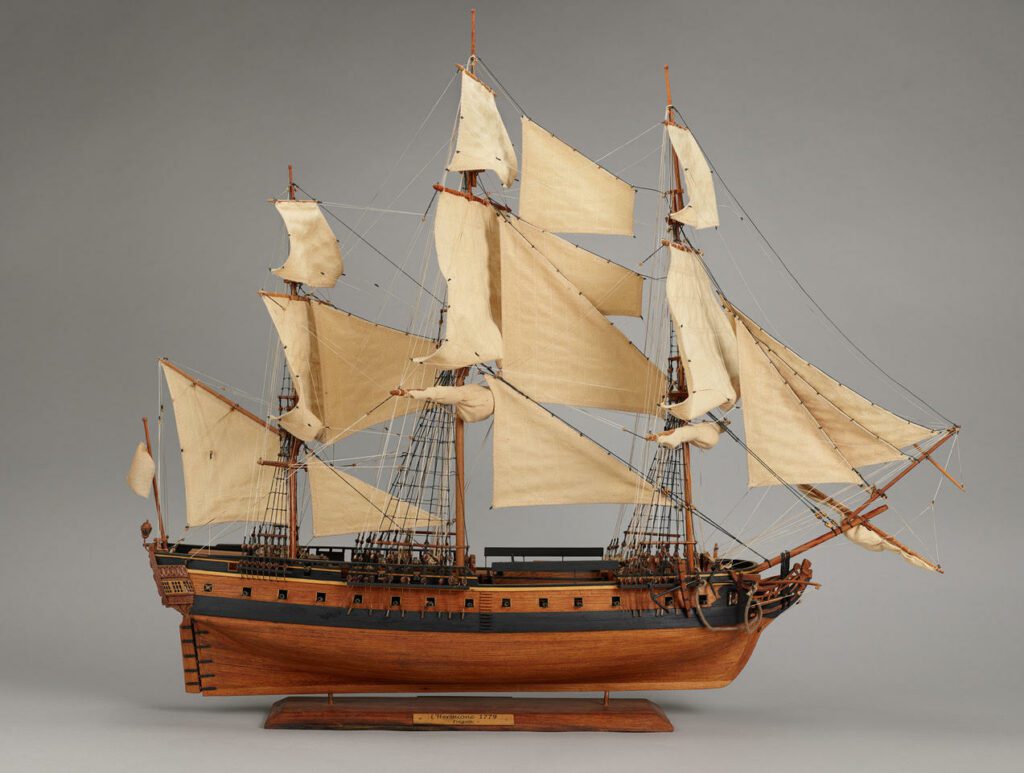
You were involved in lots of action in the Revolution culminating in the decisive Battle at Yorktown, Virginia, in 1781. During the Battle of the Capes at the mouth of Chesapeake Bay, the French fleet outmaneuvered the British fleet, which was decisive in preventing aid to the British forces at Yorktown. The British Commander, Lord Cornwallis, surrendered to George Washington on October 19, 1781. That was the effective end of the Revolutionary War.
On December 18, 1781, you left Boston for France. In Paris you then worked with Thomas Jefferson, U.S. Minister to France, on trade agreements between the two countries.
Returning to the United States in 1784-85, you were received exuberantly in Boston and elsewhere. You received an honorary Doctor of Laws degree from Harvard University. You visited George Washington at his home Mount Vernon in Virginia.
In Paris, with the aid of Thomas Jefferson, still resident in Paris, you prepared a draft Declaration of the Rights of Man and of the Citizen in July 1789, which led to a later version being adopted by the National Constituent Assembly on August 26, 1791. For you, the question of slavery was important. You tried to convince George Washington and other American leaders to abolish slavery, but without success.
Following the storming of the Bastille on July 14, 1789, you became the Commander of the French National Guard and over the years tried to maintain order in Paris and elsewhere in France. That was a difficult task, with popular opinion going for and against the monarchy. In all of that, you were promoted to Lieutenant General.
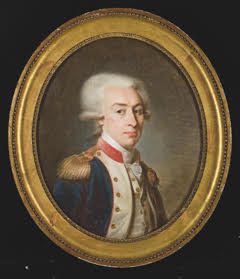
Pastel on paper. Paris, Fondation Josée et René de Chambrun, FC15.1.46
After France started war with Austria, you were captured and you remained a prisoner in various locations from 1792 to 1797. Through the help of the American representatives, you had certain privileges, and Adrienne and your daughters were with you for the last two years. General Napoleon Bonaparte negotiated your release in 1797.
The end of Napoleon’s regime was complicated. You were received by Louis XVIII in 1814. After Waterloo, when Napoleon abdicated, you arranged for his passage to America, but the British did not accept this, and Napoleon ended his days on the British island of Saint Helena in the South Atlantic Ocean.
You made a grand tour of the United States in 1824-25, visiting all 24 states then part of the Union. On December 10, 1824, you were the first non-American to address the U.S. Congress. While you were at the White House on February 9, 1825, the House of Representatives elected John Quincy Adams over General Andrew Jackson as the 6th President of the United States.
After you died on May 20, 1834, the King Louis-Philippe ordered a military funeral. In the United States, President Andrew Jackson ordered military honors for you, and both houses of Congress were draped in black for 30 days. Later, John Quincy Adams gave a three-hour eulogy for you.
Places honoring Lafayette to see while visiting Paris
In the 1st arrondissement between 202 rue de Rivoli and 211 rue Saint-Honoré stood the Hôtel de Noailles that belonged to Marie-Adrienne de Noailles’s family. In the chapel of the mansion, the marriage the Marquis de La Fayette to Adrienne de Noailles was celebrated on April 11, 1774.
It is also in this Hôtel (private mansion) that Queen Marie-Antoinette welcomed the Marquis back home from America in 1779.
In 1783, the Marquis and his family moved to the Hôtel Lafayette, which he had built at 183 rue de Bourbon. This street is now named rue de Lille. It was then and still is today one of the most elegant streets of Paris. The family, without Marie-Adrienne, who died in 1807, lived there until 1827. Unfortunately, the Hôtel Lafayette has since also been demolished.
The Treaty of Paris ending the American Revolution was signed on September 7, 1783, in the Hôtel d’York, 56 rue Jacob, in the 6th arrondissement. The United States of America was represented by Benjamin Franklin, John Jay and John Adams; David Hartley, Member of the British Parliament represented King George III.
During the last seven years of his life (1827-1834), the Marquis moved to the right bank of the Seine, in the 8th arrondissement, 8 rue d’Anjou. A plaque indicates that the General La Fayette died in this mansion on the 20th of May 1834.
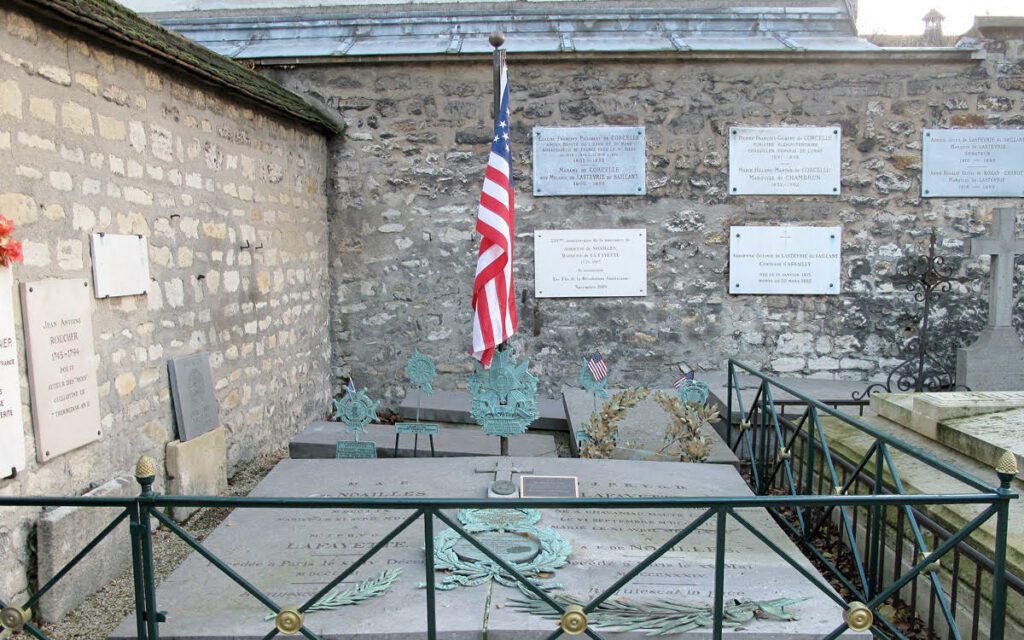
Public domain.
The Marquis and his wife are both buried in the Picpus Cemetery, 35 rue Picpus in the 12th arrondissement. The Marquis brought back some American soil from Bunker Hill in Massachusetts on his last journey from America, ten years earlier, which was to be used for his grave. On July 4, 1917, General John Pershing, Commander of the American Expeditionary Corps, and his aide Colonel Charles Stanton, visited the tomb of the Marquis, and Col. Stanton concluded saying “Lafayette, we are here!” An American flag flies on his tomb continually and during the Second World War, it was the only US flag to be seen in Occupied Paris. The Picpus Cemetery is a private cemetery open only in the afternoon, Monday through Saturday.
In the 16th arrondissement, on the Place des États-unis, stands a monument of La Fayette and George Washington, shaking hands. This statue was ordered by the American publisher Joseph Pulitzer from Auguste Bartholdi and was given to the City of Paris in 1895.
Acknowledgements: The Grand Palais RMN Editions; French National Archives in Paris; Embassy of the United States of America in France.

Comments