

The Victoria & Albert Museum in London is “dedicated to the power of creativity”. Right now, it has an exceptional temporary exhibit entitled: “Marie Antoinette Style”.
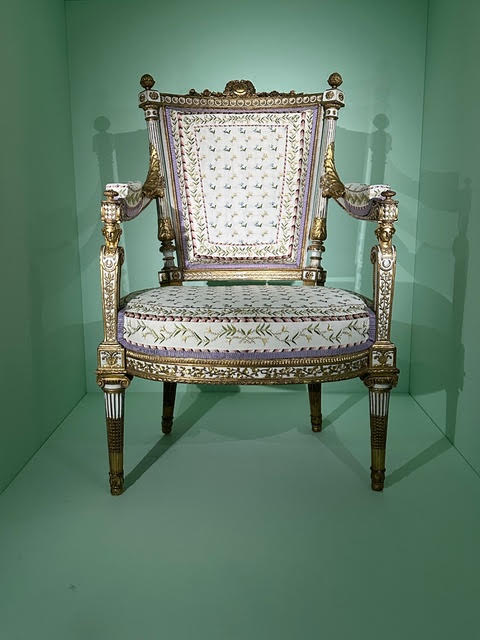
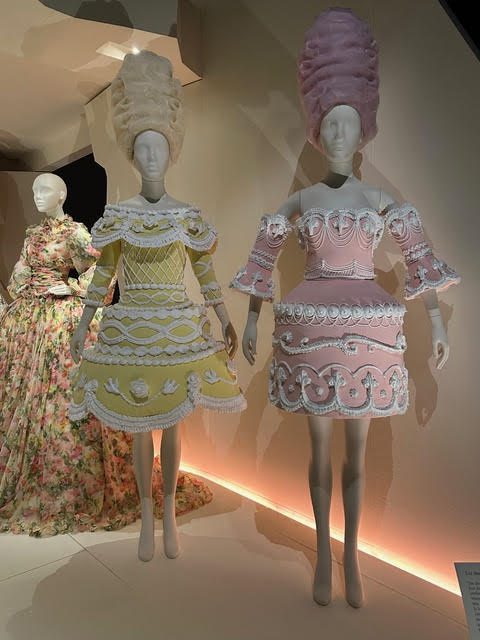
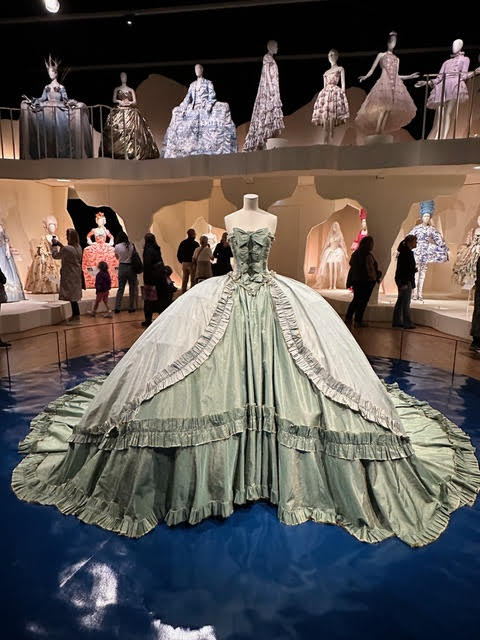
Marie Antoinette, the last Queen of France, who did not live long and who certainly died tragically, left her mark in the fashion and decorative world of the 18th century and beyond, as this show proves. This very colorful and rich exhibit is in two parts. The first part presents dresses, pieces of jewelry, furniture and objects made for Marie Antoinette during her time as Queen between 1770 and 1789. Many items have been lent by the Château de Versailles and the Trianon. The second part shows the impact of her influence still today in the fashion world (Chanel, Dior, John Galliano), in literature (Jean-Jacques Rousseau, Antonia Fraser), and in the film industry (Sofia Coppola).
Marie Antoinette was born in Vienna in 1755, the daughter of the Empress of Austria, Maria Theresa (1717-1780), and her husband, Emperor Francis I of the Holy Roman Empire (1708-1765). She left her country in 1770 at the age of 14 to go to France to marry Louis XVI (1754-1793), grandson of the then King of France, Louis XV (1710-1774). She had never been to France before, and her new residence was no less than the Château de Versailles! A few months after her arrival, finding her royal apartments too old fashioned, she decided to renovate the rooms where she was living. This was the beginning of her passion for decorating and proof of her creativity.
Upon the death of Louis XV in 1774, Louis XVI and Marie Antoinette became King and Queen of France. Marie Antoinette asked Louis XVI about a smaller palace located in the gardens of the Château. Louis XVI knew that Marie Antoinette did not like Versailles. In the catalog of the exhibit, Hélène Delalex recounted in her article “The Queen’s Private Apartments and the Petit Trianon” that Louis XVI has been said to have told Marie Antoinette, “You love flowers. I have a bouquet for you – the Petit Trianon.” … but Hélène Delalex stated that “this is pure fiction.” Still, Louis XVI gave Le Petit Trianon to Marie Antoinette.
The construction of Le Petit Trianon had been ordered by Louis XV at the wish of his favorite companion, Madame de Pompadour (1721-1764). Unfortunately, she never enjoyed it because she died before its completion. The inauguration took place in1769 at a time when La Comtesse du Barry (1743-1793) had become the King’s new favorite.
Marie Antoinette spent a lot of time there, especially during the summer months. It reminded her of her youth in Austria, a more intimate, serein environment surrounded by nature. She first renovated the gardens and then redecorated the interior which she filled with flowers.
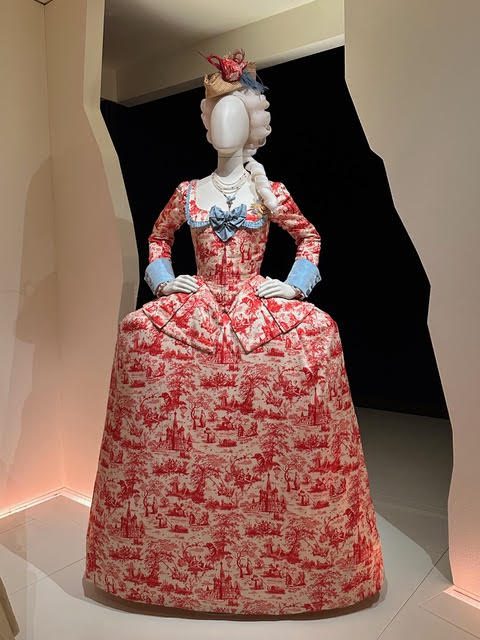
Flowers were everywhere, not only in vases but also printed on the fabrics of her dresses, of the curtains and of the wall coverings. Ironwork, furniture, and porcelain were also decorated with exquisite flower designs.
To acquire those flowery cotton fabrics, known as the “Toile”, Marie Antoinette did not have to go too far.
Toile de Jouy
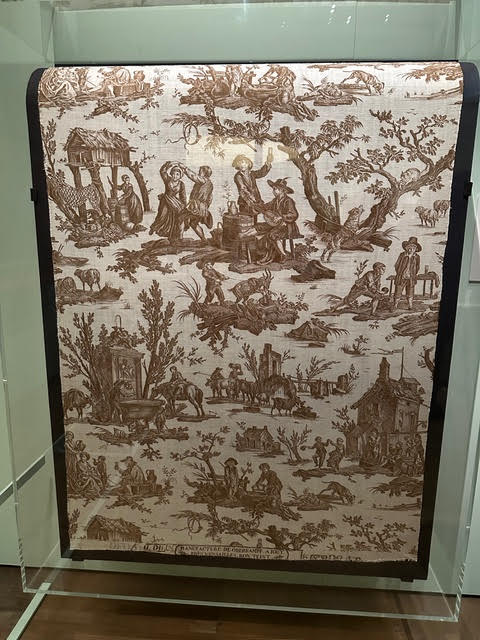
Less than 10 kilometers away, southeast of Versailles is a small town called Jouy-en- Josas. In 1760, Christophe- Philippe Oberkampf (1738-1815), born in Weisenbach (in Bavaria, today part of Germany), whose family worked in the textile industry, came to Jouy-en-Josas and created the Manufacture de Jouy. He chose this town as it was near the Court of Versailles and for its river La Briève, which had the pure water he needed for the production of the printed cotton fabrics. First, Oberkampf used woodblocks, but then he introduced the use of copperplates to print the white background fabrics, with designs in a monochrome color: red, blue or purple. At the beginning of this venture, he himself designed some fabrics inspired by Oriental and Indian motifs. Later, he commissioned famous artists, in particular Jean-Baptiste Huet (1745-1811), to create unique patterns. In addition to the floral designs, the motifs represented pastoral, rural, mythological, historical and architectural views. Between 1760 and 1843, around 30 000 designs were created.
Oberkampf was not only a precursor in the textile industry, but he was also a brilliant entrepreneur and businessman. He employed more than 1300 persons, and beyond their wages, he created lodging and schools for their families in Jouy.
In 1783, King Louis XVI granted the enterprise the prestigious title of “Manufacture Royale”.
Oberkampf died in 1815, and by 1843, the “manufacture” ceased production in Jouy-en-Josas. Today, some patterns are still reproduced on fabrics in Alsace, as they are still praised for interior decorating.
The Château de l’Eglantine houses the Musée de la Toile de Jouy (museedelatoiledejouy.fr), which opened in 1991. It owns around 12 000 objects andsets out the whole history of the textile industry from the 17th century in France and elsewhere, as well as of the span of the Manufacture Royale”. In addition to the permanent collection, temporary exhibits are organized with themes relating totextiles in general and about today’s new creations. Workshops are also organized for young visitors.
Throughout the exhibit at the V&A, many dresses, pieces of upholstered furniture and samples of fabrics made with the Toile de Jouy are displayed. In the beautiful catalog of the exhibit, a whole chapter is dedicated to Marie Antoinette’s interest in the Toile de Jouy and its creation.
Hélène Delalex wrote in her article in the catalogue: “Marie Antoinette is the only Queen to have left her personal mark on Versailles. And while we commonly refer to the Louis XVI style, it would be right to describe the style of the period as the as the Marie Antoinette style, because it embodies the quintessence of the late eighteenth century, which is so complex to grasp. Throughout Europe, her taste became the fashion and the interiors created for her, like the furniture and the objets d’art delivered to her, represent the unrivalled apex of French decorative arts.”
The exhibit ends on March 22, 2026.